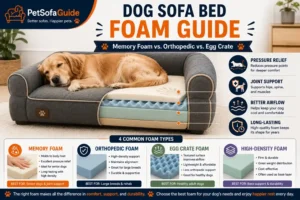
The foam inside a dog sofa bed affects much more than basic comfort. Dog Sofa Bed Foam can influence joint support, pressure relief, durability, and how well a bed maintains its shape over time. Not every product labeled “orthopedic” or “memory foam” uses the same type or quality of material.
Understanding Dog Sofa Bed Foam helps you choose a sleeping surface that matches your dog’s age, size, sleeping habits, and support needs. This guide compares memory foam, orthopedic foam, egg crate foam, and high-density support foam so you can understand the practical differences before buying.
Why Foam Matters
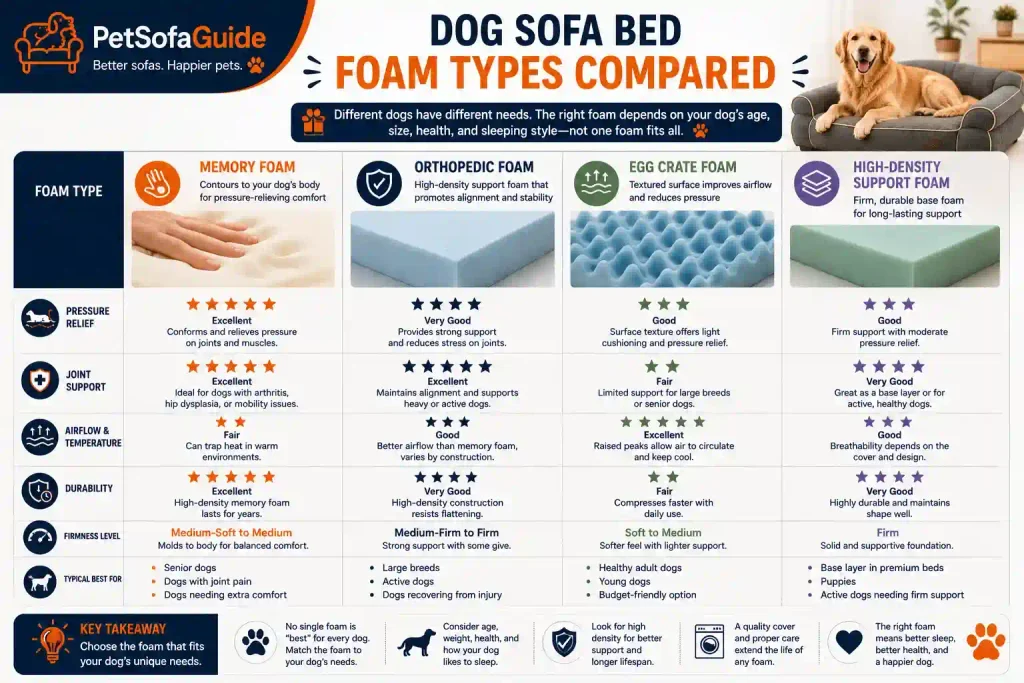
The right Dog Sofa Bed Foam can provide consistent support while your dog rests for many hours each day. The source notes that dogs may sleep around 12–16 hours daily, making the quality of their sleeping surface an important consideration.
Low-quality foam can flatten relatively quickly, leaving the dog resting closer to a hard underlying surface. Higher-quality foam is designed to maintain its shape and provide more consistent support over time.
This is particularly important for heavier dogs and dogs that spend long periods sleeping in the same bed.
Memory Foam
Memory foam responds to body heat and pressure, molding around the dog’s body. This allows weight to be distributed more evenly across areas such as the hips, shoulders, elbows, and spine.
Pros
- Excellent pressure relief
- Supports joints and muscles
- Helps reduce pressure points
- Can provide long-lasting support when made from high-density foam
- Particularly suitable for senior dogs
Cons
- Usually costs more
- Can retain some heat in warm climates
- Lower-quality memory foam may lose support more quickly
The source identifies memory foam as a strong choice for dogs with arthritis, hip dysplasia, or mobility issues.
For more information, see our Is Memory Foam Good for Dogs? guide.
Orthopedic Foam
Orthopedic foam is generally a supportive, high-density foam designed to reduce stress on joints. Importantly, “orthopedic” doesn’t necessarily mean the bed contains memory foam. Some orthopedic beds use firm support foam or layered foam systems instead.
Pros
- Excellent body support
- Helps maintain spinal alignment
- Suitable for heavier dogs
- Generally more durable than standard foam
Cons
- Quality varies between manufacturers
- Premium orthopedic models can cost more
Orthopedic foam is presented in the source as an excellent option for senior dogs, large breeds, and dogs recovering from injuries.
See our Best Orthopedic Dog Sofa Beds guide for related recommendations.
Egg Crate Foam
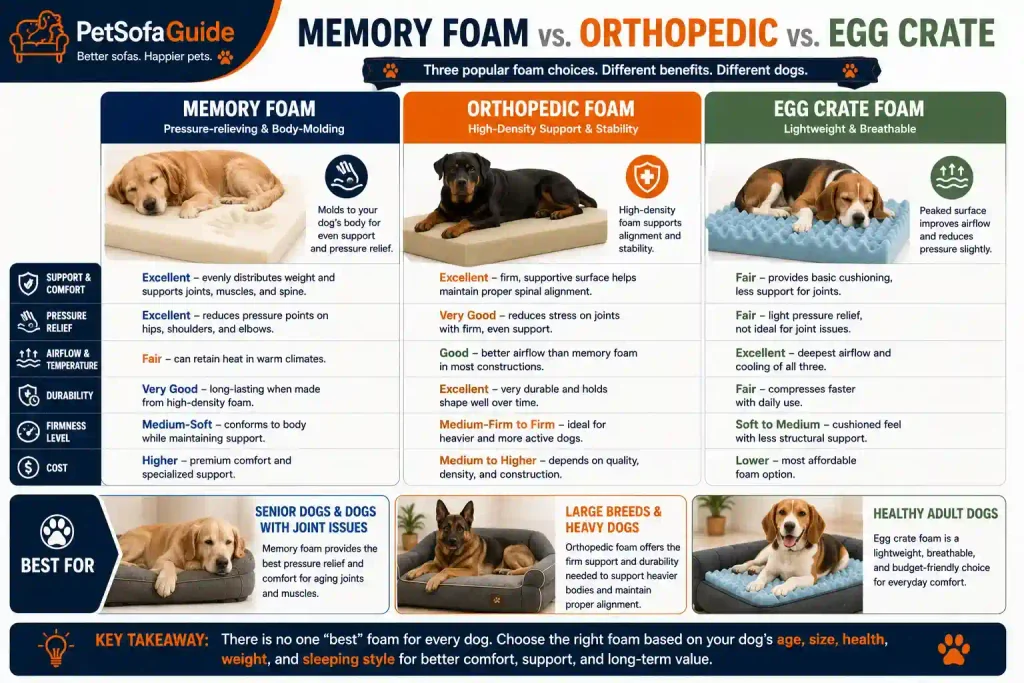
Egg crate foam has a distinctive textured surface with raised peaks. The design can improve airflow while providing a degree of cushioning and pressure reduction.
Pros
- Lightweight
- Better airflow
- More affordable
- Comfortable for many healthy adult dogs
Cons
- Less durable
- Can compress faster
- Provides less orthopedic support than memory foam
Egg crate foam can work well for younger or healthy adult dogs, but it may not provide enough support for large breeds or senior pets.
High-Density Support Foam
High-density support foam is another common material used in dog beds. Some manufacturers use high-density polyurethane foam rather than memory foam.
Its potential benefits include:
- Firm support
- Better durability
- Good weight distribution
- Lower cost than memory foam
High-density support foam is also commonly used as a base layer underneath memory foam in premium orthopedic beds.
Which Foam Is Best?

There isn’t one universally best Dog Sofa Bed Foam type for every dog. The source recommends different materials according to the dog’s needs.
| Dog Type | Recommended Foam |
|---|---|
| Puppies | High-density foam |
| Healthy adult dogs | Egg crate or support foam |
| Senior dogs | Memory foam |
| Large breeds | Orthopedic foam |
| Dogs with arthritis | Memory foam |
| Dogs with hip dysplasia | Orthopedic memory foam |
If your budget allows, the source identifies high-quality memory foam as generally offering the best overall combination of comfort and longevity.
However, the right choice still depends on the individual dog’s size, age, and support requirements.
Foam Density Explained
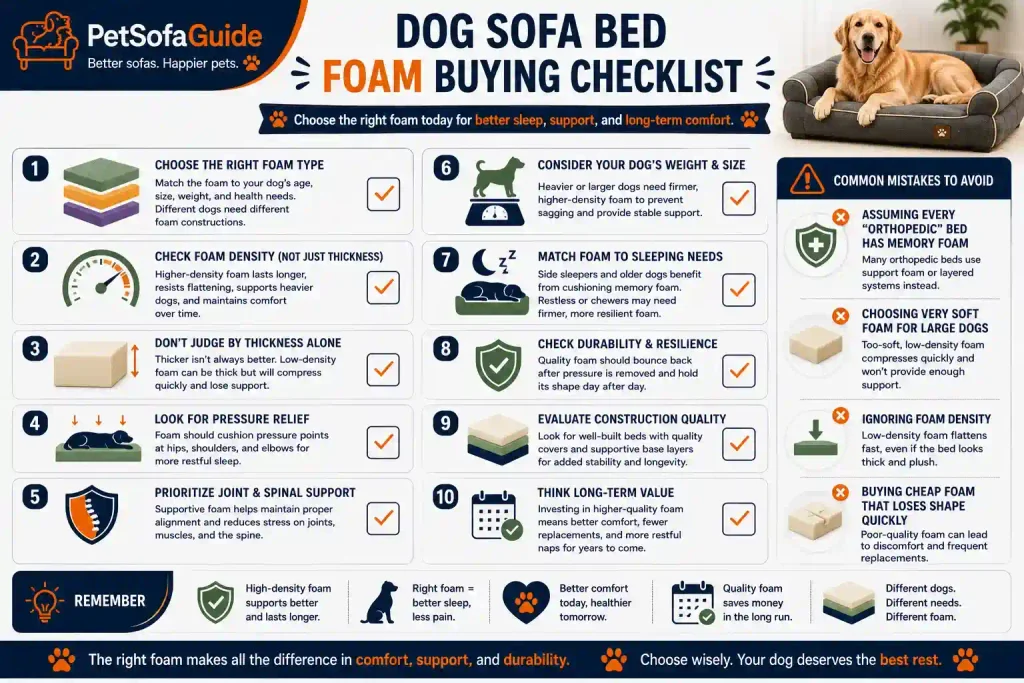
When evaluating Dog Sofa Bed Foam, don’t assume that a thicker cushion automatically means better quality.
The source emphasizes that foam density can have a greater effect on durability than thickness. Higher-density foam generally:
- Lasts longer
- Resists flattening
- Provides better support for heavier dogs
- Maintains comfort for longer periods
Very soft, low-density foam may feel comfortable when new but can compress relatively quickly under daily use.
Therefore, checking the manufacturer’s specifications for foam density can be more useful than judging a bed by its thickness alone.
Common Buying Mistakes
Many shoppers focus on the advertised foam name without examining what is actually inside the bed. When comparing Dog Sofa Bed Foam, avoid these mistakes:
- Assuming every “orthopedic” bed contains memory foam
- Choosing a bed based only on thickness
- Ignoring foam density
- Selecting very soft foam for large breeds
- Buying inexpensive foam that loses its shape quickly
Reading the product specifications carefully can help you identify better-quality construction.
Frequently Asked Questions
What is the best foam for a dog sofa bed?
The source identifies memory foam as a generally strong option because of its:
- pressure relief
- joint support
- potential for long-lasting comfort
Is memory foam better than orthopedic foam?
Not necessarily. Orthopedic beds can contain memory foam, while some use high-density support foam or layered systems.
The overall quality depends on the materials and construction rather than the label alone.
What is egg crate foam?
Egg crate foam has raised peaks that can improve airflow while providing light cushioning.
It can be comfortable for healthy dogs but generally provides less support than memory foam.
Does thicker foam mean better quality?
No. Foam density is generally more important than thickness when evaluating durability and long-term support.
High-density foam is more resistant to flattening than low-density foam.
Which foam is best for senior dogs?
The source recommends orthopedic memory foam as a strong choice because it can reduce pressure on joints while supporting aging muscles and bones.
Final Thoughts
Choosing the right Dog Sofa Bed Foam can make a meaningful difference in comfort and long-term durability. Egg crate and standard support foam may work well for many healthy dogs, while memory foam and orthopedic foam offer stronger pressure relief and support for senior dogs, large breeds, and dogs with joint-related needs.
Higher-quality foam can also help the bed maintain its shape for longer, potentially reducing the need to replace flattened cushions frequently.
The key is to look beyond marketing terms. Consider the dog’s age, size, weight, sleeping habits, foam density, and support requirements before deciding which construction is appropriate.
For more buying advice, explore Is Memory Foam Good for Dogs?, Best Memory Foam Dog Sofa Beds, Best Orthopedic Dog Sofa Beds, and How to Choose the Perfect Pet Sofa Bed.